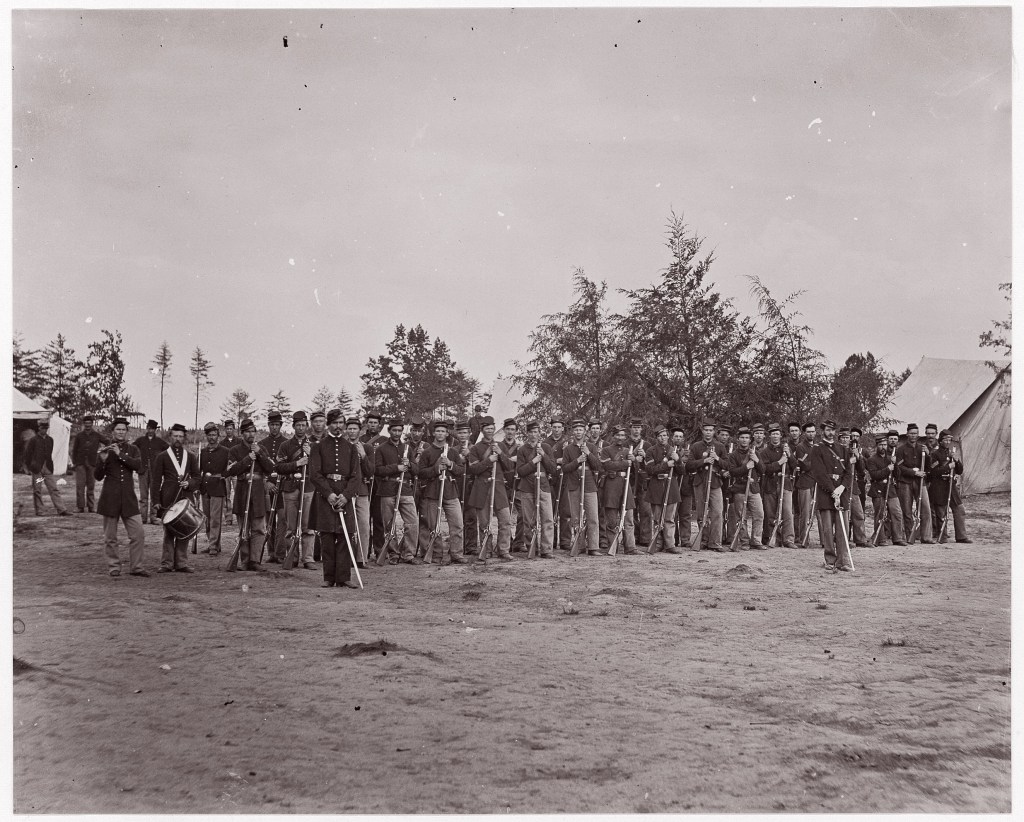
The 1st Reserves in the Civil War
In April of 1861, both the North and the South expected a relatively short war. Abraham Lincoln issued a call for 75,000 volunteer troops divided among the states, to serve for a term of three months. The response from the people of Pennsylvania was overwhelming, exceeding their allotted number by thousands of men. US Secretary of War Simon Cameron, a political enemy of Pennsylvania Governor Andrew Curtin, refused to accept the excess volunteers. Rather than send them home, Governor Curtin, with the approval of the state legislature, equipped and organized the extra men into the 15 regiments (13 infantry, 1 artillery, and 1 cavalry) of the Pennsylvania Reserve Volunteer Corp. These regiments stood ready to defend the state against any potential Confederate invasion.
With the Union defeat at the First Battle of Bull Run in July, and with most of the Army’s three month enlistments nearly over, the War Department called for more recruits. The call was answered by the Pennsylvania Reserves, already organized, equipped, and trained. Mustered into US service as the 30th through 42nd Pennsylvania Volunteer Infantry Regiments, they were often still referred to by their Reserve numbers. These regiments would serve until June 1864. Reassigned multiple times to different corps in the Union Army, they nonetheless remained together as a single division throughout their service.
Company D of the 1st Reserves was recruited from Lancaster County, and chose as their nickname the Safe Harbor Artillery. Their Captain was George H. Hess. Assembled into Pennsylvania Service June 9, 1861, they were mustered into the US Army as the 30th Infantry on July 26. Initially they were assigned to General John Dix’s command. Between March and April 1862, they were transferred to George McCall’s division, then 2nd Division, I Corp, then McCall’s again.
In June they were attached to the 1st Brigade, 3rd Division, V Corps, Army of the Potomac and ordered to the Virginia Campaign, where they would be heavily engaged in the Seven Days Battles. Captain Hess was wounded and captured June 30th at Charles City Crossroads and died four days later.
In late August the regiment was transferred to 1st Brigade, 3rd Division, III Corps, Army of Virginia. Under this command they would engage in two days of combat at the Second Battle of Bull Run. With barely two weeks rest, on September 14, the regiment would participate in the Battle of South Mountain, this time with 1st Brigade, 3rd Division, I Corps, Army of the Potomac. In this battle they drove the defending Confederates from the summit on the north side of Turner’s Gap. From Turner’s Gap they marched west to Antietam, and drove back Rebel skirmishers on the 16th. After a night of continuous skirmishing, they helped repulse an attack in the East Woods on September 17.
On December 12, the Pennsylvania Reserve Division, under George Meade, crossed the Rappahannock River at Fredericksburg and took up positions on the Union left. The following afternoon, the division led the attack on Jackson’s front along a railroad line. Finding a 600 yard gap between two of Jackson’s brigades in a marshy area, they pushed through. When the Union reserves behind failed to reinforce them, they were eventually driven back by an overwhelming Confederate counterattack.
After the defeat at Fredericksburg, the regiment began marching toward Banks’ Ford for another attempt to cross the Rappahannock, but a torrential rain turned roads to mud, and threatened to make the river impassable. After turning back, the Reserves were assigned to XXII Corps in February, and sent to defensive positions around Washington, D.C.
When Lee began marching north in June 1863, the Pennsylvania Reserve Division was attached to V Corp, Army of the Potomac, and began marching in pursuit. Between June 25 and July 2, the division covered eighty miles to reach Gettysburg. On arrival they took up a position in reserve on the north slope of Little Round Top. Late that day, as Confederate forces made one final push through the Wheatfield, General Samuel Crawford, on horseback, seized the colors from the color corporal of the 1st Reserves. The corporal, unwilling to surrender his flag, grasped Crawford’s pant leg and followed as the General led the division in charging down the slope of Little Round Top and into the Wheatfield. The charge drove the Rebel forces back, leaving the Wheatfield under Union control. The next day, the division took part in clearing the Rose Woods of Confederate troops.
The Pennsylvania Reserves went on to engage with the enemy at Williamsport, Bristoe Station, Rappahannock Station, Mine Run, the Wilderness, Spotsylvania Courthouse, North Anna River, and Totopotomoy before being mustered out on June 10, 1864. Many of the regiment’s men reenlisted, and along with men from the other Reserve regiments, formed the 190th and 191st Pennsylvania Invantry. These two regiments would serve through the remainder of the war, including significant action during the siege of Petersburg.
 1st Pennsylvania Reserves, Co. D Reenactors